

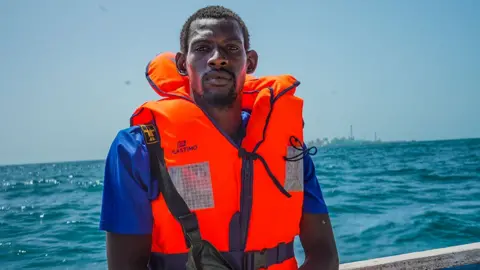
Every day, a local fisherman, who works in the northern coastal city of St. Louis, heads to sea with conflicting feelings: optimism and disappointment.
He hopes he will have better luck than yesterday, yet he is discouraged by the thought that whatever he finds might not cover expenses.
"Before, we fished to make a living, but now we just work to survive," explains the young fisherman.
In the same situation, numerous artisanal, traditional fishermen in Saint-Louis - a major fishing hub - are struggling to survive.
The main culprit: LNG platform
Numerous fishermen and people linked to the fishing industry all blame one cause - a liquefied natural gas platform that is located on the maritime border between the two West African nations, off the coast of Saint-Louis.
The expensive gas development is projected to produce roughly 2.3 million tonnes of LNG per year for over 20 years.
However, residents of Saint-Louis say this also comes with fishing limitations which ninety percent of the city's population of more than a quarter million rely on for survival.
Limited access and economic impact
After motoring 10km offshore, fishermen get near the large platform but cannot get any closer due to a 500m exclusion zone which restricts fishing.
"Officials forbid us to fish in that area of the facility, under threat of confiscation or even destruction of our fishing equipment if we access it," explains one fisherman.
Local fishers say the facility sits around a underwater reef teeming with marine life – the limitations mean their yields decrease and they barely earn a living.
"We feel hopeless," admits one fisherman. "Now we can stay until late afternoon waiting idly, without any catch."
Economic impact on fishing communities
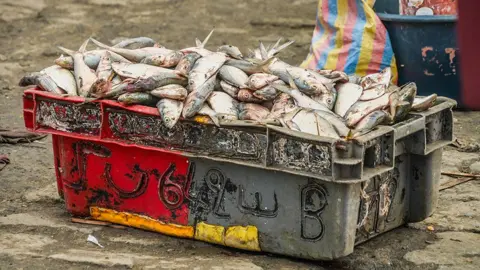
Processing is typically predominantly done by women. But with the decrease in the number of fish in Saint-Louis, many are becoming unemployed.
Diamol Sène, who dries salted fish in the open air, says many workers who once worked with her at a fish processing site are now without work.
"Fish has become too expensive, shipping expenses are high. Nowadays, we earn just enough to cover expenses," says the parent with ten children.
Local fishers say they previously earned between $445 and $625 from a day's fishing, but nowadays, they struggle to get ninety dollars.
Decreasing income are forcing numerous fishers, to think about leaving their centuries-old practice.
"We have no choice to persist with our fishing activity, because we have few alternatives," he says. "But if a employment chance appears, we will take it without hesitation."
Other work options and unfulfilled commitments
Others have left behind fishing for alternative opportunities, including seeking work abroad.
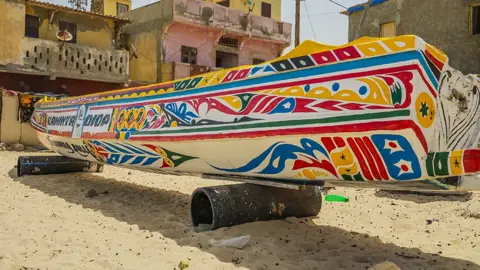
Among them who stopped fishing is 38-year-old a former fisherman. For several years, the experienced fisher has started working as a carpenter - making, repairing and painting canoes.
"Now, I earn a better living with woodworking than with catching fish," he admits.
Although he acknowledges the carpentry job is inconsistent, he feels fishing has become "extremely challenging" because of the LNG facility.
Representatives of a local association supporting small-scale fishers in Saint-Louis say the company has failed to deliver its commitment to build alternative fishing areas where they could improve their harvest.
"When they came in 2019, they told people: 'We're going to build you multiple fishing reefs' to at least replace our traditional fishing grounds," says Nalla Diop.
However, he says that six years on "nothing has been done."
Environmental concerns and continuing conflicts
The operators says in recent years, assessment research and additional analysis revealed that only a couple of 12 reef sites were "assessed as being feasible for a reef of substantial size."
Fishermen say operators plans to build the alternative fishing area just four kilometers from the coastline, calling the location as unsuitable to attract fish.
Recently, there was an incident called "gas bubbles" in a production well.
An environmental activist, a Dakar-based marine advocate with a conservation group, says gas leaks could have "significant impact" on the environment.
"Operators has not revealed the true quantity of the gas leak," states the campaigner.
He says experts found that such a gas leak had the ability to destroy marine fauna and flora, reefs, algae and resources that allow fish to feed.
Economic uncertainty for local residents
Representatives of the artisanal fishermen in Saint-Louis say the assurance of economic prosperity through the gas development comes at a great cost.
They argue it prevents them of unrestricted entry to their traditional fishing grounds, leaving them with an uncertain future.
Additionally, they blame the authorities of supporting the operators to their disadvantage.
"We only have the sea to survive from," says one fisherman.
While developments proceed, local residents in northern Senegal face an challenging choice between economic development and traditional livelihoods.


